
Scarborough family cooks up a 150-year-old summer tradition
On a sunny Sunday afternoon Harold F. Snow sits between family members, enjoying a lunch of clams and lobsters. But the lunch is about more than the food. It’s about a family tradition that is more than 150 years in the making.
The meal is part of the Snows’ annual clambake, a tradition that dates back to the early 1800s when Harold’s great-grandfather Enoch Snow made his way from Massachusetts to Maine.
“We’ve been doing these clambakes for as long as I can remember,” Harold said after finishing his dinner of clams, lobster and corn on the cob. “This is something my family enjoys doing and it’s a longstanding tradition.”
Harold will turn 92 on Aug. 22. He was born in Scarborough in 1917 into a family that made its living and reputation through clams and clambakes.
His father, Fred, dug clams, put on clambakes and ran a fish market before he began Snow’s Canning Company in 1921, a company for which Harold eventually designed the equipment that allowed it to distribute its products nationally.
“This is what we do,” said Harold’s daughter Susan Snow. “We have one of these every year to celebrate the family. I can’t remember a time when we didn’t have a clambake.”
Harold, who has an engineering degree from Massachusetts Institute of Technology, said he only missed one bake. “I was just out of school and I was working for Dupont,” he said. “That’s the only time I can remember missing one.”
The Snows’ ties to Scarborough and their clambakes began with Capt. Enoch Snow. After moving his family to Wells and later, Scarborough, in the 1840s, Enoch began harvesting clams to use as bait for commercial cod fishing. At that time, locals enjoyed the white-shelled clams cooked on the shore over seaweed on heated rocks, as the Indians had taught them in the 1600s.
After the Civil War, the Boston and Maine Railroad came to Pine Point. As a result, clambakes became a tourist attraction. The railroad also enabled clammers to easily distribute their products outside of Pine Point, leading Enoch to become a clammer instead of a sea captain.
“That was a tough decision for him to make,” Susan said. “It was a tough life back then.”
In the 1950s, Harold and his father took the clambake to an astonishing level. As part of an advertising campaign for Snow’s Cannery, the family helped put on the world’s largest clambake. Five thousand people attended the Massachusetts event. “Oh, I couldn’t tell you how many pounds of clams we cooked,” Harold said. “I do know no one complained about the food.”
Hollywood immortalized Enoch – and the “real nice clambake” – in the 1950s with the movie/musical “Carousel.”
In the 1940s the writing duo Rogers and Hammerstein searched for traditional names to give the characters in their play, set in an 1870s New England fishing village. They chose Enoch Snow, the name of Harold’s great-grandfather and grandfather, for the secondary male lead.
20th Century-Fox made the movie, with actor Robert Rounseville playing the Snow role, and the crew teamed up with Snow’s Canning Company for cross-advertising, which prompted the huge clambake.
Movie stars Shirley Jones, Gordon MacRae and Rounseville, stayed overnight in Harold Snow’s home at 230 Pine Point Road – a former one-room schoolhouse Harold had attended – and the Snows treated them to a clambake on the beach at Pine Point.
“I think that’s pretty amazing,” said Susan’s son Corey Snow. “This really is something that is special to my family.”
On Sunday, the family continued the clambake tradition as relatives from around the country enjoyed the traditional food. Using a brick-oven stove, they heated a large metal plate on top for an hour. They placed seaweed on top of the plate and nestled baskets filled with lobsters and clams into the seaweed. Placing more seaweed on top of the baskets, they covered the food with a canvas and let it steam for an hour before eating.
“This is a pretty traditional bake,” Corey Snow said. “People used to heat rocks, place seaweed on the rocks and cook it that way. Either way, it just provides a good flavor to the food.”
Harold recalls using that original method. The rocks took five hours to heat up before food could be placed on them, he noted. He and his family used to put the rocks in barrels and bake the food on the boats as they headed to area islands to host clambakes.
“That way the food was ready to go before we got there,” he said. “I do prefer the older way of baking. I think it tastes better, but how we do it now is quicker.”
The Snows said they will continue hosting their family clambake and look forward to next year. The event is so popular among the family members that relatives will cut into busy schedules just to make the trip to Maine. “I wouldn’t miss this,” said Arin Snow, who is an economics and math Ph.D. candidate at Northwestern University. “I flew in on Friday and will be leaving Monday, but every part of it was worth it.”
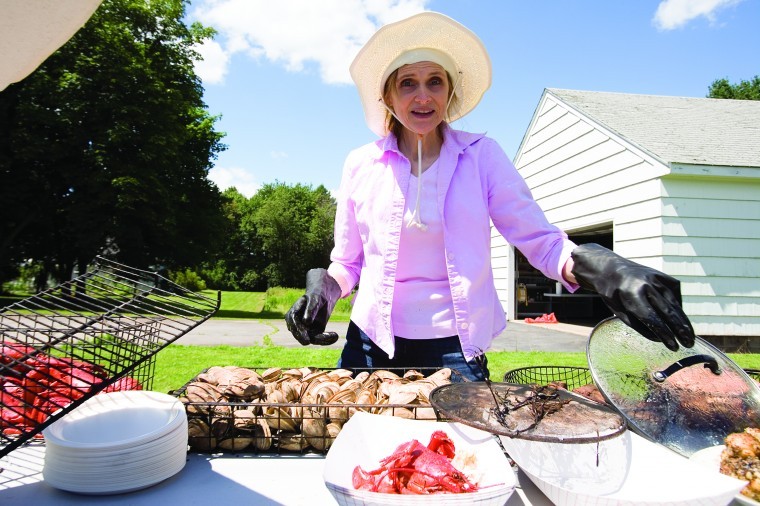 Susan Snow checks on the family clambake bounty Sunday. The annual event has taken place for more than 150 years.
Comments are no longer available on this story