
Value comes in many forms. To some people, value looks like new buildings, homes and other signs of wealth, tangible and visible.
To Dennis Hawkes, it also looks like empty fields and forests, stretching out over the horizon, a peaceful buffer to encroaching development. It looks a lot like Windham’s Clark Farm.
“It keeps that feeling of openness. It protects the water quality, the air quality, all those things,” said Hawkes, president of the Windham Land Trust, one of three groups working together to raise funds to buy the Clark property, a 550-acre tract of farmland and forest that straddles Route 202 and features beautiful vistas and popular spots for hiking, fishing and snowmobiling. There are also acres of good soil that would be set aside for the next generation of farmers, a way to continue Windham’s rural tradition while taking advantage of the growing demand for locally grown food.
The Land Trust, along with the Maine Farmland Trust and The Trust for Public Lands, has raised $1.2 million toward the price of $2.6 million. On July 14, the Windham Town Council will hold a public hearing on a proposed $1 million bond to help complete the transaction with Larry and Ann Clark, who own and live on the property. The council will then vote to place the bond on the November ballot. An anonymous donor has pledged $200,000 if the town also makes a contribution.
Under the plan, 233 acres would remain farmland and would be sold with restrictions to one or two farmers. The Windham Land Trust would add 76 acres to its Black Brook Conservation Lands, and the remaining 242 acres, near the Swett Road, would stay open to recreation under an easement held by The Trust for Public Lands.
The Clarks, who have lived there for 40 years, would stay in their home on the land, but would be giving up development rights over the property.
“We have nothing against development,” said Ann Clark. “But this is pretty special out here.”
The town would be wise to move quickly on preserving the land, members of the fundraising groups argued last month as the Town Council debated the bond. The Clarks, who started looking into preservation 10 years ago and got together with the Land Trust five years ago, want to preserve the property, but also want to use the proceeds from the sale for retirement, and can only wait so long to sell.
And, the fundraising groups argue, anyone who has watched Windham over the last 20 years knows that development is both relentless and permanent. The Clark property, said Jim Gooch, project manager for The Trust for Public Lands, has room to handle 155 new house lots.
“It never goes back to trees,” said Hawkes.
To Bond or Not to Bond
While many residents recognize the value of open and untouched land, convincing them to spend $1 million to preserve that land may be a challenge, said Hawkes and Gooch.
Bonding to purchase land for the sake of preservation has been successful on the state level through the Land for Maine’s Future program, but it has not been used often by municipalities in Maine, Gooch said. Scarborough and Falmouth residents have both approved bonds for that purpose, he said, but Mainers have not had the kind of widespread familiarity needed to become comfortable with local land bonding.
The key, said Gooch, is to picture land preservation along business and residential development as part of a town’s economic strategy. Residents would not balk at spending money to fix bad roads or repair schools, he said.
“It is as critical as any piece of infrastructure,” he said. “The quality of community is an investment.”
In fact, said John Piotti, president of the Maine Farmland Trust, there are a lot of hidden costs in development. The increase in the cost of town services related to new homes usually outweighs any additional tax revenue brought in by the development.
“Residential development does not pay its way in taxes,” said Piotti. The farmers that worked the land would pay taxes but not require much in the way of services, while the rest of the land, open to the public, has its own kind of value, he said.
“Here’s something that is a one-time cost that is going to provide an economic return,” said Piotti.
If a $1 million bond is approved by voters, it would likely add around $10 a year to tax bills for the 20-year life of the bond, which Hawkes thinks is a bargain.
“$10 a year? Not much for a whole lot of open space,” he said, adding that places like the Clark Farm are the reason why a lot of Windham residents moved there in the first place.
“What is going to happen if that goes away? Are they all going to move to another rural setting?” he said.
Land in transition
The movement to protect the Clark Farm is coming at a crucial point for farming in Maine, said Piotti, also a state representative from Unity.
Where once the major hurdle was finding farmers to work the land, the renewed interest in farming and locally grown food has brought new people to the industry. These new farmers are entering the market at a time when the older generation is looking to retire.
In the next 10-15 years, around 400,000 acres of land will be in transition, simply because of the age of the landowners, said Piotti. In order to keep this land in agriculture, the new farmers have to get the land at an affordable price.
“The major need in Maine agriculture is now getting people who want to farm on land in an affordable way,” said Piotti. “The critical piece is making sure that the land is available.”
If the land is preserved well, and the farmer holds little debt, farming will always be the best and highest use of land, he said. The problem comes when they are competing for land with developers, who are willing to pay a price that cannot be supported by the small margins of farming.
Take for instance a successful farmer who, ready to retire, sells his land to another farmer at the price offered by developers, said Piotti.
“The next day, it could be the same farm, the same products, the same markets. But if the new owner is sitting on an extra $500,000 of debt because he had to pay developer prices, the economics is very different,” he said.
The proposal also comes as the United States is at the beginning of a shift away from an economy dominated by fossil fuels, said Piotti. In 25 years, the need for locally produced food will be so clear as to be inarguable. The state has to begin that transition now in order to have the infrastructure in place, he said.
“Food relies on unsustainable transportation, labor and water,” Piotti said.
Contrary to popular belief, Maine is in a good position to grow its agriculture industry. While a lot of attention has been given to the plight of dairy farmers over the last year, the number of farms and farmers in Maine has been steadily growing, and the potential exists for further growth, Piotti said.
There are around 1 million acres of land with prime soil in Maine, and another 8-9 million acres of cleared land for livestock, Piotti said. The state is also within a day’s drive of 70 million people along the eastern seaboard, providing a huge market for the farms. Locally, the greater Portland area gives Windham farmers an advantage.
“These farms do best if they are close to the population. We actually see a lot of opportunity in Cumberland County,” said Piotti.
Setting aside the economic concerns for a moment, Hawkes recalls the part of his youth spent working on the family farm in Windham. Those farms added something to the community, both commercially and spiritually, he said.
“Almost everyone worked on a farm growing up. Not one of them would have a bad memory about it,” said Hawkes. “It could still happen.”
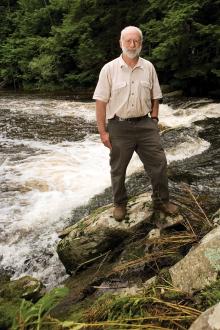 Larry Clark and his wife, Ann, of Windham would like to preserve for all time their 550-acre piece of farmland and forest off Route 202. The Windham Land Trust is working with two other preservationist groups to raise funds for the purchase of an easement, and on July 14 the Windham Town Council will hold a public hearing on a proposed $1 million bond to help complete the $2.6 million deal.
Comments are no longer available on this story