
One of Maine’s few low-power community radio stations may go silent this fall unless organizers can get help from local businesses and community members.
David Patterson, program manager at WJZF 97.1 FM in Standish, said the station can no longer afford the roughly $500 a month it costs to keep airing its diverse group of locally produced programs, including “The Bud Sawyer Show,” “The Maine Show” and “Lane and Tommy Unglued,” while also providing air time for local organizations. On air since 2005, WJZF can reach as far as Portland and Limerick with its signal, and around the world with its live-streaming Web site.
“We have absolutely no listener support, no underwriter support, and the costs are just escalating to the point where we can’t operate even a low-power station on our own,” said Patterson, who runs the nonprofit station out of a studio that takes up the back corner of his home off the Bonny Eagle Road.
If Patterson cannot engineer a turnaround by Oct. 1, WJZF will turn to static, leaving just two other radio stations of its kind in Maine: WJZP in Portland and WRFR in Rockland. These low-powered stations are ultra-local by design, with short signals and programming unlikely to be found elsewhere. They are especially important now, supporters said, as commercial stations more and more become the property of large conglomerates.
“Otherwise, there isn’t any local radio,” said Joe Steinberger, founder of WRFR, which for seven years has sent its signal from what is now the only broadcast studio in Knox County. “There are a number of antennas, but the studios are in Augusta.”
The dearth of low-powered radio stations is attracting attention nationally as well. A bill from U.S. Rep. Mike Doyle, D-Pennsylvania, would repeal restrictions on the number of licenses granted to low-powered stations that were put in place because larger, commercial stations felt signals from smaller stations were causing interference. The bill is now in committee, and Doyle told Congressional Quarterly it is likely to become law this year.
The problem began with the Telecommunications Act of 1996, which Patterson said deregulated radio and allowed companies like Clear Channel, which owns around 1,200 stations, to homogenize the industry.
As the rules were changed to benefit the larger stations and radio conglomerates, the little guys were pushed aside, Patterson said. It became difficult for the small stations to get approved for power upgrades, or to avoid being dwarfed alongside the larger stations, which have infinitely more resources and clout.
As result, he said, it is hard to tell the difference between a station in Maine, and one across the country. Therein lies the power and worth of a local, community radio station, Patterson said.
“They’ve killed diversity on the airwaves,” said Patterson. “I don’t fault the business interests. What I do fault is that the public suffers. There’s no room for personality.”
With a station like WJZF, broadcast out of a bedroom by a mix of radio old timers and committed amateurs, you’ll get personality in spades, said Tommy Gleason of Windham, who with Lane Hiltunen does the weekly political show, “Lane and Tommy Unglued.” Depending on when you tune in, you might hear blues, bluegrass, oldies, country, or local theater and talk.
“It’s different,” said Gleason. “It’s all across the board. There is something for everybody. Everybody brings something different. It’s hard to find a station that has that mix.”
The station’s tune changes program to program, but the informal format also allows hosts to switch things up within their own show. Bud Sawyer, a 50-year veteran of Portland-area radio and host of his eponymous show on WJZF, said he enjoys using the station’s loose nature to weave together different types of music.
A lyric from a Willie Nelson song segues nicely, thematically, into a selection from Chet Atkins and the Boston Pops. Before you know it, you’ve made the link for the listener, however subconsciously, between pop, country and classical music, Sawyer said.
“It is a shame, and an insult to the listener, to put music in a box,” said Sawyer. “Why do I have to play all the same stuff? With this station, I can tell a story.”
The same applies to “Lane and Tommy Unglued.” The pair can talk local, state or national politics, or as they have done before, they can turn the airwaves over to a group of students from Windham High School, and let the kids run things the way they see fit.
“We gave them a different voice that day. It wasn’t what we thought,” said Gleason.
“It is a sort of voice-of-the-people thing,” said Keith Halliburton, who writes and directs the Three Aliens Radio Theatre, part of the Schoolhouse Arts Center in Standish. “So many of our stations are computerized or out of another state. Dave offers people a chance to get on the air.”
Patterson said it is impossible to know for sure how many people listen to WJZF, a station too small for a tracking system. But through e-mails and phone calls, he can tell the station has a loyal and dedicated, if relatively small, audience.
“They become hooked,” he said.
The programming at WJZF, its depth, breadth and unique nature, should be attractive for listeners, and for businesses who want to serve as underwriters, getting a mention for each spot, Patterson said.
But the business community has to be engaged, said Steinberger, who ran into similar funding issues in Rockland. He eventually hired an advertising representative to work on commission to get underwriters, and it has worked out well. Maine’s small business owners react positively to his station’s mission and their similar place in the pecking order.
“They are to Home Depot what we are to Clear Channel,” said Steinberger.
Patterson just hopes enough business owners will take the time to check out WJZF. If they do, he said, they will find at least one show worth supporting.
“I would like to challenge every business in the listening area to look at the station and see if there is something they would like to underwrite for $50 a month,” said Patterson.
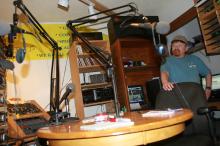 Dave Patterson, program manager at WJZF 97.1FM, said the community radio station may have to close this fall if financial support cannot be found. The low-powered station, which broadcasts out of a studio in Patterson’s Standish home, features a variety of local, community-minded programs, including The Bud Sawyer Show and Lane and Tommy Unglued.
Comments are no longer available on this story