
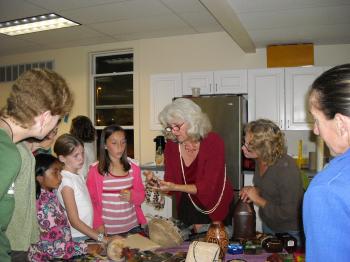
The Hear Our Stories Cafa opened last week, attracting some 50 students, parents and residents to Cape Elizabeth Middle School for an evening of stories and exhibits from nine immigrants from Brazil and Guatemala.
The cafa – a three-part series – along with a multicultural book group and World Language Week activities, are part of the middle school’s efforts to promote diversity and global understanding. The program, called CEMS Global Connections 2008, is funded by a grant from the Cape Elizabeth Education Foundation.
Although billed as a lecture, the evening was an informal, round-table discussion. Prompted by questions from moderator Susan Dana, the panelists at the Sept. 25 cafa talked about their countries’ location, language and population, their personal reasons for coming to the United States, differences in cultures and holiday celebrations, how they learned English and what they miss most about their native homes.
Carlos Luck, originally from Brazil, said he came to the United States in 1989, with his wife and infant child in tow, to pursue his doctorate in electrical engineering in Los Angeles. A job offer from the University of Southern Maine brought them to Maine in 1995. He sprinkled humorous anecdotes throughout his discussion of Brazil, its traditions and culture, and the differences between the two countries.
USM was also instrumental in Maria Antonieta’s immigration from Brazil to Maine. She met her husband, a teacher at the university, when he went to Brazil as part of an exchange program. Because she was fluent in English and born by the mouth of the Amazon, he asked her to be his guide around the area. Despite her fears and love of her home, she accompanied him to Maine in 1994. When asked what she found difficult about coming here, she said that when she met new people it was “difficult to break the ice, but then they became great friends.” She also spoke of the difficulty of leaving family behind. Her advice to students trying to learn a new language was to set a goal of learning three to five words a day and to continue increasing their vocabulary.
Ana-Maria Gonzalez, originally from Guatemala, came to the United States with most of her family. After his cousin married a woman in Maine, her father suggested that they all move there, as well. He wanted them to have more educational opportunities and a better life.
Family was a frequent theme as she spoke throughout the evening. When addressing the differences between Guatemala and the United States, she cited the fact that people don’t eat lunch at home here. In her homeland, everyone returns home for a two-hour meal with their family. When asked what she missed most about her home country, she said, “It’s hard to answer because family and friends is my country.”
The one question posed by Dana that got all of the panelists to respond was regarding the difference in holiday celebrations. Although Carnival in Rio de Janeiro was mentioned, they all spoke of Christmas and birthday celebrations, noting that while in the U.S., invitations are for specific people and have a start and end time, in their countries all are welcome and parties can go on and on. The audience learned that in both Brazil and Guatemala, Christmas is celebrated on Dec. 24 with a late-night meal, followed by the opening of presents at the stroke of midnight. Guatemala also has a country-wide fireworks display, where neighbors compete to have better shows and save all year long for.
The next event in the Hear Our Stories Cafa series is scheduled for Thursday, Oct. 16, at 7 p.m., at the Cape Elizabeth Community Service Center. Admission is free and community members are encouraged to attend.
 Cape hears immigrants’ stories
Comments are no longer available on this story