
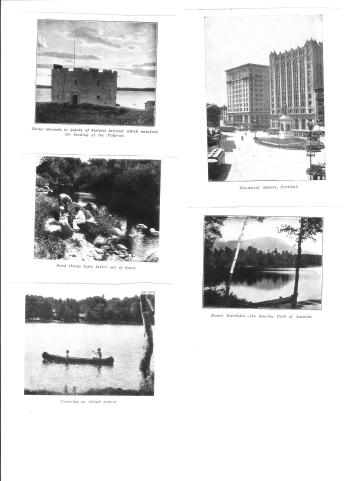
Included among the many historical ephemera donated to the Cape Elizabeth Historical Preservation Society by its late founder Dr. Constance Murray, is the booklet, “Facts About Maine,” published by the Maine Development Commission, 1936, portions of which are included here.
“The State of Maine is one of the most healthful, beautiful, and interesting states in the Union. Since the days of the earliest settlers, Maine has been recognized for her marvelous advantages.
“Its geographical location, topography, and climate make it an ideal region in which to work or play. Its lakes, mountains, seacoast and other recreational assets make it a mecca for vacationers the year round.
“The varied topography is 320 miles long, 210 wide at its widest part and has a total area of 32,500 square miles. The direct coastline of nearly 250 miles is so notched with bays and inlets that it has a tidal line of more than 2,400 miles, equal in length to one-half of the entire coast line of the United States.
“Within its borders there are 2,465 lakes and ponds from the smallest to the largest: Moosehead. There are five large rivers. The highest elevation in the state is Mt. Katahdin reaching more than a mile above sea level the peak of which is the first spot in the United States to greet the morning sun.
“Maine has 26 ports of entry, Portland is considered the largest. Eastport is the most easterly city in the United States, but when traveling in a straight line across the Atlantic Ocean, Portland Head Light is 116 miles nearer Europe (Lisbon, Portugal) than any other American port.”
Hidden among the various trivia about this area, we find: “Maine winters are not as severe as in corresponding latitudes in interior states. The air in summer is devoid of the dry, scorching heat that abounds in treeless sections of the country and in densely populated cities. Summer nights are always cool.”
The remaining 40 pages contain statistics about agriculture and the variety of crops harvested; farms and numbers of livestock and dairy products produced; acres of forestry with their stands of timber and numbers of board feet of lumber cut.
One factory uses 5,000 cords of wood annually to manufacture clothespins produced for the housewives who dry laundry outdoors on a clothesline. A cord of sound birch wood will yield 9,000,000 toothpicks, the mill producing a total of about 170,000,000 annually.
Other categories relate facts regarding education, health, highways, summer residents and tourists, transportation, sea and shore fisheries and fish and game regulations to help preserve nature for the future.
According to the booklet, Maine was justly classified as having resources unmatched by any other state.
 History Matters – Boosting Maine, 1936 version
Comments are no longer available on this story