
Frank Gorham said he hasn’t had time to plan for life after retirement.
He did say he would like do some fly-fishing and spend more time with his wife, two children, and two grandchildren.
“I want to just relax away from the commitment,” Gorham said about his retirement June 26 as superintendent for School Administrative District 61.
Commitments kept Gorham busy during his three-year term.
With the 2008-09 budget completed and passed by district voters May 20, Gorham and the SAD 61 School Board have met the challenge of making up for decreased state subsidies through cuts in personnel and services, at least for now.
Gorham has also seen the district through the state’s mandated re-organization process, passed by the Maine Legislature in June 2007. The Maine Department of Education, which administers the law, approved the SAD 61 plan to remain an independent district despite not having the required 2,500 students.
“His biggest challenges have been with the budget and with state consolidation and with all the loss of state funding the district has had,” said Lake Region High School Principal Roger Lowell. “He’s had to spend a lot of energy trying to deal with those issues.”
Lowell said he has known Gorham since before they both worked for SAD 61. “He has a good perspective on education and kids and how you treat people,” Lowell said. He added that Gorham has gone a long way toward eliminating hard feelings between town officials and the school district.
“He was really good about having a transparent and open administration,” said Casco Town Manager David Morton, who stressed that communication is key to a successful school administration. Gorham himself said there needs to be a close partnership between the school district and town officials.
Director of Lake Region Vocational Center Rosie Schacht described Gorham as “terrifically supportive of our students,” adding that she has seen a strong focus on curriculum development while he has been superintendent.
Gorham, 59, of Gray, taught elementary school in Raymond for 13 years before taking a position as principal for the Crooked River Elementary School in Casco in 1996. He served as interim superintendent in 2001 and then filled a new position as director of instructional programs for SAD 61. When the previous superintendent, Klauss Peter Voss, resigned in 2005, Gorham took his position.
Being superintendent isn’t that different from being a principal or a teacher, Gorham said, though as superintendent, “you’re engaged with every aspect of what’s happening in the district on a daily basis.”
“This particular district experienced the largest subsidy cut,” Gorham said, explaining that the state cut funds because property values in the district have risen considerably while the number of students has stayed constant. “We’re pretty lean,” Gorham said, adding that it has been hard to have to lay people off and consolidate bus runs.
The re-organization process was also a challenge. SAD 61 looked for ways to increase efficiency and considered merging with SAD 55, which covers Baldwin, Cornish, Hiram, Parsonsfield and Porter and SAD 72, which serves Brownfield, Denmark, Fryeburg, Lovell, Stoneham, Stow and Sweden. The three districts found no economic benefits to consolidating, Gorham said, and so they put in a request to the state to stay independent. The request was granted last month.
Gorham said there have been many changes in the 37 years he has worked in Maine education. Schools now experience more assessment demands and a greater responsibility to state and federal education departments and the importance of technology has grown enormously.
When Gorham started his career, Maine did not have a set of learning results and the 2001 No Child Left Behind act brought stricter federal guidelines. Gorham pointed out that 11 years ago the district had one staff member who focused on technology and now there’s a whole department.
Though Gorham said he has no advice for Patrick Phillips, the incoming superintendent, he did say that the decrease in state subsidies will be an issue. “We’ve reduced our budget as low as we want to, or can,” Gorham said, indicating that the district will have to invest money into programming and facilities in the future.
Bridgton town manager Mitchell Berkowitz agreed. “I think the district is going to have financial problems going forward,” Berkowitz said.
Lowell, however, didn’t foresee huge future changes. “Facilities are a major challenge,” Lowell said. “They will be for years.” This summer a committee of school board members and town representatives will come together to complete a facilities plan that may include closing the Bridgton Memorial School, which houses the adult and community education program.
Gorham pointed out that work on the lower level of the Lake Region Middle School will be finished soon, allowing sixth-graders to join the seventh- and eighth-graders in the fall. This will allow the district to implement their alternative plan, starting by closing Casco Memorial School, which houses special education offices and a handful of students.
Gorham said he especially enjoyed working with and hearing from school staff, town residents and selectmen, which gave him a broad perspective of the district. “I think I’m going to miss the day-to-day connections with colleagues,” Gorham said. “They are very dedicated people. They care deeply about children.”
While Gorham doesn’t know if he will continue to be involved in public education or not, he does plan to continue volunteering at the Maine Wildlife Park in Gray.
“I’ll be doing something,” Gorham said.
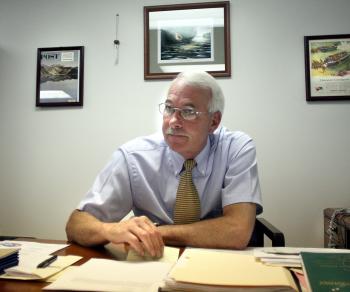 SAD 61 Superintendent Frank Gorham will retire June 26 after a three year tenure. He called balancing budgets with decreased state subsidies the biggest challenge of his job, others say his demeanor
Comments are no longer available on this story