
Community Development Director Roger Timmons is breaking character and asking the town to help him computerize his records.
“I’m no computer person,” said Timmons, a farmer who’s worked for the town for the last three decades. He said the ink on the town’s subdivision plans are fading and he wants the town to create a computer database with all the information.
“I’m not for all this technology, but I am for this, because it works,” he said.
The state’s subdivision laws took effect on Feb. 7, 1972 and when a development plan is approved by the town a list of rules for the property are included. These “special conditions for approval” were written by hand on the older subdivision plans.
“Unless you put it on the plan, it isn’t enforceable,” said Timmons. He said the problem is the ink is fading on these plans and the town would be powerless to uphold its approval conditions if someone broke the rules.
In 1988, the Maine Supreme Judicial Court ruled 4 to 1 in City of Portland v. Grace Baptist Church that towns need to have written conditions explicitly described on a subdivision plan in order to enforce them. The ruling set a precedent that would allow land owners to ignore approval conditions if the subdivision plans are not preserved.
Tammy Hodgman, an assistant to Timmons, received an estimate of $39,000 to put the records into a computer database. She said it would cost about $2,500 each year to maintain it.
“It could be expanded on,” she said, saying the database could encompass other records for the planning board, zoning board of appeals and code enforcement office. She said the town’s current computer system is outdated and could crash and be lost and a new system is needed.
“We have all the old files in the basement and everywhere, it’s a mess,” said Timmons. He said the paper file system the town has now is arcane and he wastes a lot of time hunting for files. He said the paper system is so complex that the planning board may miss some of the approval conditions when they pass new plans for a property.
“Roger hates to hunt,” said Hodgman. Last winter, Hodgman set up an electronic database of the letters the department has received during the last 30 years. The paper copies themselves take up a small three-row bookcase.
“It just makes sense to have it all in a computer,” said Timmons.
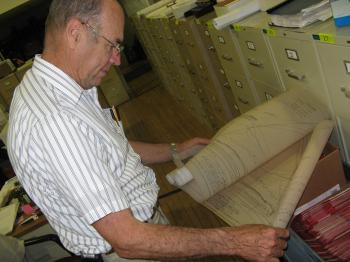 Timmonsplans1-4: Community Development Director Roger Timmons look over one of hundreds of subdivision plans at his office. Timmons said the ink is fading on some of the plans and the town needs to put them into a computer database or they will all be lost.
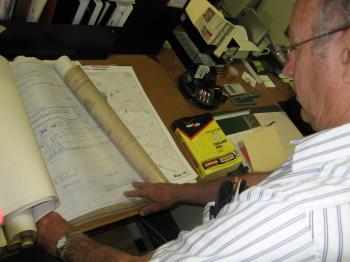 Timmonsplans1-4: Community Development Director Roger Timmons look over one of hundreds of subdivision plans at his office. Timmons said the ink is fading on some of the plans and the town needs to put them into a computer database or they will all be lost.
 Timmonsplans1-4: Community Development Director Roger Timmons look over one of hundreds of subdivision plans at his office. Timmons said the ink is fading on some of the plans and the town needs to put them into a computer database or they will all be lost.
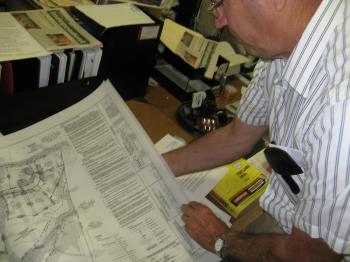 Timmonsplans1-4: Community Development Director Roger Timmons look over one of hundreds of subdivision plans at his office. Timmons said the ink is fading on some of the plans and the town needs to put them into a computer database or they will all be lost.
 Timmonsplans5: Community Development Director Roger Timmons shows the fading ink on a subdivision plan. The section in black ink was traced over by one of his assistants recently.
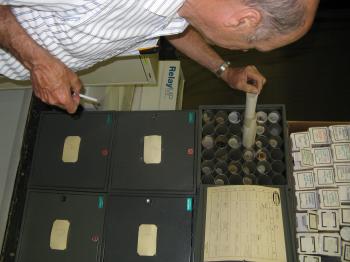 Timmonsplans6: Community Development Director Roger Timmons shows the arcane paper filing system of the towns subdivision plans. He said there are about 650 plans in these cabinets, which does not include the files in the basement.
Comments are no longer available on this story