Posted inLakes Region Weekly

King talk explores climate’s impact on Maine ice fishing

5 min read

U.S. Sen. Angus King, I-Maine, was set to discuss the impacts of global climate change on Maine’s ice fishing season Thursday at the Naples Town Hall.

According to Maine-based scientists, the long-term increase in Maine’s average annual air temperatures since the late 19th century has caused the ice-out date on many of the state’s lakes to occur earlier and earlier in the season, with Sebago Lake showing a particularly sharp retreat. With average annual temperatures projected to continue rising, scientists expect the long-term retreat of the ice-out date to continue, posing threats to the popular sport of ice fishing.

On April 3 from 2:30-3:30 p.m., after the Lakes Region Weekly deadline, the lawmaker was scheduled join anglers, environmentalists and a University of Maine biology professor to discuss how climate change is putting ice fishing “on thin ice” as well as “how the ice fishing community can raise its voice on this issue.”

“I’m a great believer that you have to talk about real cases, not abstract theories,” King said. “This is the future of the Sebago Lake Ice Fishing Derby; it’s the future of the lobster industry in Maine; it’s the future of the maple syrup industry in Maine; it’s the future of the snowmobiling and ski industry in Maine. This is practical stuff.”

According to the “Maine’s Climate Future 2015” report released last month by the University of Maine, average annual temperatures in the state increased about 3 degrees from 1895 to 2014, primarily due to the sharp buildup of greenhouse gases in the atmosphere since the Industrial Revolution.

In Maine, climate change has manifested itself in a long-term decline in average annual snowfall totals, rising sea levels, warming ocean waters, and a long-term increase in total annual precipitation levels and extreme precipitation events, according to the original version of the report, which was compiled by 70 scientists and published in 2009. According to the report, climate change in Maine has caused an increase in the incidence of Lyme Disease, changes to the maple syrup production schedule, rising insurance costs, a northern migration of Maine’s lobster harvest and a host of other effects.

Advertisement

According to the report, Maine’s warm season, which begins when the average daily temperature is above freezing, increased by two weeks from the early 1900s through the 2000s, and Maine’s average winters have warmed at a faster rate than its summers. In the 2009 report, the increasingly early date of ice-out on Maine’s lakes was attributed to the long-term rise in average temperatures.

According to David Hart, a University of Maine biology professor and the director of the George Mitchell Center for Sustainability Solutions as well as the author of the freshwater section of the 2009 report, Sebago Lake’s average annual ice-out date has retreated several weeks since the early 1800s. According to records compiled by the United States Geological Survey, the average annual ice-out date on Sebago Lake typically occurred in late April in the early 1800s. By the 1990s, the average ice-out date typically occurred in late March. According to Hart, despite this year’s extreme cold, which has extended the ice-out date, the long-term retreat of ice-out dates will likely continue.

“There is a long-term trend of ice-out happening earlier in the year across many lakes in Maine and many lakes in the northeast,” said Hart, a speaker at the Naples event. “This is related to the long-term trends of increasing air temperatures. Even though in any given year there may be wide variations from that trend – and this year is one of them, ice-out is going to be really late this year in many places – the long-term trend is clear.”

According to Hart, Sebago Lake’s large size and depth makes it especially susceptible to the effects of warmer temperatures. Hart said it is difficult to attribute a single tragic event or early ice-out to climate change. But a long-term trend can be seen, he said.

“Across many lakes the trend is clear that ice-out is occurring earlier in the year, over these long time spans (of) many, many decades,” he said.

Warm weather in recent years has played havoc with the Sebago Lake Rotary Club’s annual ice fishing derby, which started in 2001. The derby was cancelled in 2012 due to poor ice conditions and was held only on other lakes in 2013 due to poor ice conditions. In 2010, the derby was curtailed prematurely after people and equipment fell into a rapidly melting Jordan Bay on the first day of the derby. That year, Sunday’s portion of the derby was canceled and a man died trying to lift his submerged snow machine the following Monday.

Advertisement

Thursday’s event in Naples, considered the heart of the Lakes Region, was sponsored by the groups Environment Maine, Trout Unlimited, Maine Rivers, Maine Lakes Society, the Sebago Lake Anglers Association, Lakes Environmental Association and the Loon Echo Land Trust.

According to King, Maine’s recreational fresh-water fishing industry is worth about $250 million annually. King, who recently spoke at the Island Institute in Rockland about the effects of ocean acidification – which scientists believe is another symptom of global climate change that is affecting the Gulf of Maine – said Mainers are increasingly noticing changes in the state’s natural environment.

“People don’t necessarily say, ‘This is an issue of global climate change,’” King said prior to the Naples event. “They do say, ‘Boy, things are changing.’ Part of what has to happen is people have to see the two as connected. Of course, there’s a difference between weather and climate and I’m not one to say every single snowstorm or hurricane or severe winter is an indication that this is part of a global phenomenon. When you add it up, you can’t really avoid the conclusion that something’s going on out there and it’s having an impact on everything from the Iditarod to catching sea horses in lobster traps on the coast of Maine.”
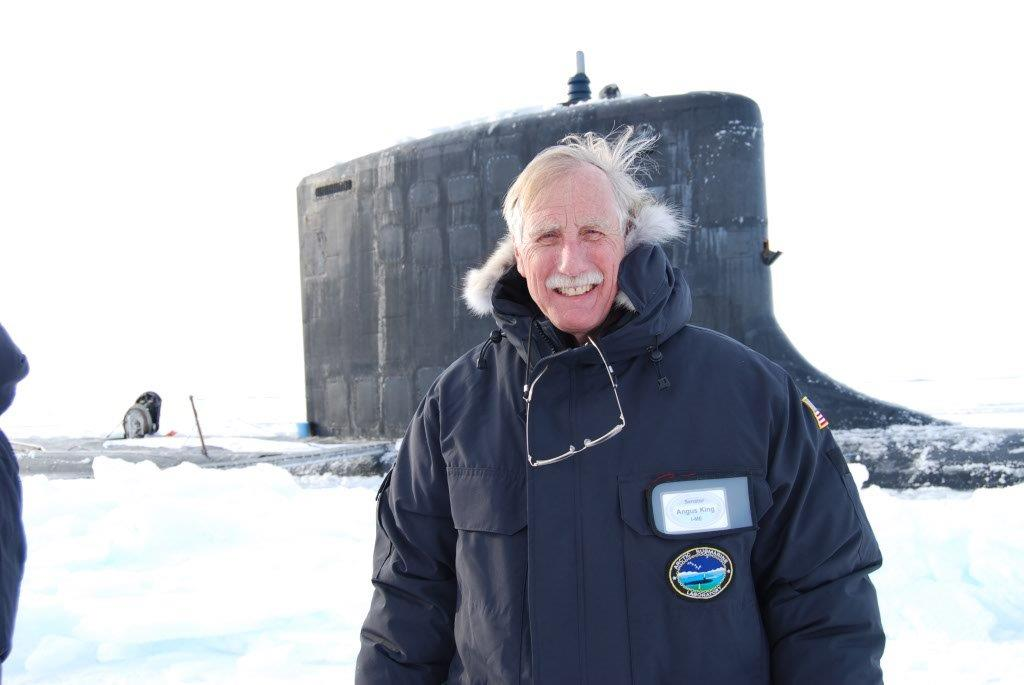
Sen. Angus King, seen here in front of a submarine in the Arctic, was scheduled to speak in Naples on Thursday making a link between global climate change and earlier ice-out on water bodies in the Lakes Region.Courtesy photo

Comments are no longer available on this story

Posted inLakes Region Weekly

King talk explores climate’s impact on Maine ice fishing

5 min read

U.S. Sen. Angus King, I-Maine, was set to discuss the impacts of global climate change on Maine’s ice fishing season Thursday at the Naples Town Hall.

According to Maine-based scientists, the long-term increase in Maine’s average annual air temperatures since the late 19th century has caused the ice-out date on many of the state’s lakes to occur earlier and earlier in the season, with Sebago Lake showing a particularly sharp retreat. With average annual temperatures projected to continue rising, scientists expect the long-term retreat of the ice-out date to continue, posing threats to the popular sport of ice fishing.

On April 3 from 2:30-3:30 p.m., after the Lakes Region Weekly deadline, the lawmaker was scheduled join anglers, environmentalists and a University of Maine biology professor to discuss how climate change is putting ice fishing “on thin ice” as well as “how the ice fishing community can raise its voice on this issue.”

“I’m a great believer that you have to talk about real cases, not abstract theories,” King said. “This is the future of the Sebago Lake Ice Fishing Derby; it’s the future of the lobster industry in Maine; it’s the future of the maple syrup industry in Maine; it’s the future of the snowmobiling and ski industry in Maine. This is practical stuff.”

According to the “Maine’s Climate Future 2015” report released last month by the University of Maine, average annual temperatures in the state increased about 3 degrees from 1895 to 2014, primarily due to the sharp buildup of greenhouse gases in the atmosphere since the Industrial Revolution.

In Maine, climate change has manifested itself in a long-term decline in average annual snowfall totals, rising sea levels, warming ocean waters, and a long-term increase in total annual precipitation levels and extreme precipitation events, according to the original version of the report, which was compiled by 70 scientists and published in 2009. According to the report, climate change in Maine has caused an increase in the incidence of Lyme Disease, changes to the maple syrup production schedule, rising insurance costs, a northern migration of Maine’s lobster harvest and a host of other effects.

Advertisement

According to the report, Maine’s warm season, which begins when the average daily temperature is above freezing, increased by two weeks from the early 1900s through the 2000s, and Maine’s average winters have warmed at a faster rate than its summers. In the 2009 report, the increasingly early date of ice-out on Maine’s lakes was attributed to the long-term rise in average temperatures.

According to David Hart, a University of Maine biology professor and the director of the George Mitchell Center for Sustainability Solutions as well as the author of the freshwater section of the 2009 report, Sebago Lake’s average annual ice-out date has retreated several weeks since the early 1800s. According to records compiled by the United States Geological Survey, the average annual ice-out date on Sebago Lake typically occurred in late April in the early 1800s. By the 1990s, the average ice-out date typically occurred in late March. According to Hart, despite this year’s extreme cold, which has extended the ice-out date, the long-term retreat of ice-out dates will likely continue.

“There is a long-term trend of ice-out happening earlier in the year across many lakes in Maine and many lakes in the northeast,” said Hart, a speaker at the Naples event. “This is related to the long-term trends of increasing air temperatures. Even though in any given year there may be wide variations from that trend – and this year is one of them, ice-out is going to be really late this year in many places – the long-term trend is clear.”

According to Hart, Sebago Lake’s large size and depth makes it especially susceptible to the effects of warmer temperatures. Hart said it is difficult to attribute a single tragic event or early ice-out to climate change. But a long-term trend can be seen, he said.

“Across many lakes the trend is clear that ice-out is occurring earlier in the year, over these long time spans (of) many, many decades,” he said.

Warm weather in recent years has played havoc with the Sebago Lake Rotary Club’s annual ice fishing derby, which started in 2001. The derby was cancelled in 2012 due to poor ice conditions and was held only on other lakes in 2013 due to poor ice conditions. In 2010, the derby was curtailed prematurely after people and equipment fell into a rapidly melting Jordan Bay on the first day of the derby. That year, Sunday’s portion of the derby was canceled and a man died trying to lift his submerged snow machine the following Monday.

Advertisement

Thursday’s event in Naples, considered the heart of the Lakes Region, was sponsored by the groups Environment Maine, Trout Unlimited, Maine Rivers, Maine Lakes Society, the Sebago Lake Anglers Association, Lakes Environmental Association and the Loon Echo Land Trust.

According to King, Maine’s recreational fresh-water fishing industry is worth about $250 million annually. King, who recently spoke at the Island Institute in Rockland about the effects of ocean acidification – which scientists believe is another symptom of global climate change that is affecting the Gulf of Maine – said Mainers are increasingly noticing changes in the state’s natural environment.

“People don’t necessarily say, ‘This is an issue of global climate change,’” King said prior to the Naples event. “They do say, ‘Boy, things are changing.’ Part of what has to happen is people have to see the two as connected. Of course, there’s a difference between weather and climate and I’m not one to say every single snowstorm or hurricane or severe winter is an indication that this is part of a global phenomenon. When you add it up, you can’t really avoid the conclusion that something’s going on out there and it’s having an impact on everything from the Iditarod to catching sea horses in lobster traps on the coast of Maine.”

Sen. Angus King, seen here in front of a submarine in the Arctic, was scheduled to speak in Naples on Thursday making a link between global climate change and earlier ice-out on water bodies in the Lakes Region.Courtesy photo

Comments are no longer available on this story