
CAPE ELIZABETH – A 19th-century lighthouse lens on display in the Cape Elizabeth town office for the past 18 years will soon be moved – the only questions are how far will it go and who will pay for the journey?
On April 11, the Town Council voted to turn the light over to the Coast Guard, which loaned it to the town in 1995, because of costs associated with moving it to a new location within the town office. However, the Coast Guard curator in Washington, D.C., said Tuesday that if her office comes and get the lens as requested, the town will still have to cover the cost of packing and moving the historic artifact, wherever it may go.
The 1,800-pound Fresnel lens, considered “second order” by its size and focal length, was made in Paris, France, in 1874 and, for many years, it graced the east tower at Two Lights.
“At one time, it had the highest candle-watt power on the entire eastern seaboard, greater than Portland Head Light,” said Councilor Jessica Sullivan.
In 1995, the lens was moved from the Coast Guard station in South Portland to Cape Elizabeth under a 10-year loan agreement. At that time, the Coast Guard had the lens assessed at $1.5 million.
Skip ahead to 2013, roughly six weeks ago, when the town decided it wanted to move the light from its home in a corner of the lobby near the town clerk’s office.
Plans are to house the assistant town clerk in a nearby office and, to make room for a new service window, the lens was to be trucked to a back corner of the council chambers.
That’s when prospects of keeping the lens in town began to dim.
According to Town Manager Michael McGovern, the town pays $2,630 per year to insure the lens, a fee that would jump to considerably, he said, if insured to an updated value of $2.5 million.
Coast Guard curator Arlyn Danielson said Tuesday the lens only has to be insured to $1 million. However, the loan agreement, which she said “remains in force” even though it expired in 2005, could weigh heavy on any relocation attempt.
Coast Guard specifications mandate that disassembly and reassembly of the lens, even for a short trip across town hall, be done only by a qualified and approved lampist. There are five lampists in the country certified by the Coast Guard to work on second-order Fresnel lenses – the nearest in New York.
“It’s a very small list,” said Danielson. “Unfortunately, this is one of those very highly specialized skill sets.”
According to the town’s facilities director, Greg Marles, the move would take four days, during which time the town would be responsible for the lampist’s food, lodging and travel expenses, in addition to his fee.
“I wish I could tell them, ‘No, this is a really inexpensive proposition,” said Danielson, “but any time you move Fresnel lenses, it’s going to be rather expensive. They are very old and very fragile and, essentially, works of art. It is essential that any work at all done to them be handled with the utmost care and skill.”
But the expense does not stop there. Any move will require new glazing for the entire lens, which then must be protected from ultraviolet rays and curious fingers by a glass or plastic enclosure. At the town office, the lens is out in the open, without so much as a velvet rope to segregate it from the public.
According to McGovern, the new display requirements and the hike in insurance could top $7,500, combined.
On April 11, the Town Council met in its capacity as the directors of the Museum at Portland Head Light, and, based on McGovern’s recommendation, voted unanimously to give the lens back to the Coast Guard.
At that meeting, the council also approved the fiscal year 2014 budget for the museum, which includes $544,061 in spending on $547,200 in projected revenue, primarily gift shop sales. At that, there’s not even room in the budget for the presumed increased in insurance for the lens.
“It’s really an important part of our national heritage,” said McGovern. “I question whether our priority should be for us to pay the expense to maintain it, or whether it ought to rightfully stay with its owners, the United States Coast Guard.”
McGovern told the council the town will honor stipulations of the original 10-year agreement. However, Danielson said there is one significant wrinkle in that agreement, which McGovern admitted he had not read. If the town relinquishes custody of the lens, said Danielson, it’s on the hook for the cost and packing and moving it wherever it may go. In other words, it will still have to hire the specialist anyway, with a trip elsewhere in the state significantly more expensive than a move across town hall.
“Sometimes, it just cheaper to hang on to it,” said Danielson.
However, if the council still wants to relinquish the lens, Danielson said she will work to find “an appropriate custodian and steward,” preferably somewhere in Maine.
“If they are not interested in carrying the lens anymore, than I will try to find someone else in the local area who would be interested in taking it rather than bringing it back here [to Washington, D.C.] and putting it in storage, which I an reluctant to do because these lenses are so beautiful,” said Danielson. “We’d like to keep them someplace accessible and visible to the public.
Although both Danielson and Marles say the old loan agreement is between the U.S. Coast Guard and the town of Cape Elizabeth, McGovern said Monday that taxpayers will not have to cover moving costs. Instead, that cost would be borne by the Museum at Portland Head Light.
Although Marles says “It’s all part of the town,” McGovern has described the museum as a separate entity that happens to include the Town Council as its board of directors.
”I am happy to honor the obligations we made when we first borrowed the lens,” McGovern said via email Wednesday. “The differential between the lighthouse revenue and expenditures has been narrowing. Yet, the property is in great shape so I think we will have less expense in the near term. The museum has a fund balance of about $500,000 to help pay for issues such as relocating the lens.”
(This story has been updated from the print version to clarify some of the potential costs and use of the museum’s fund balance in moving the lens.)
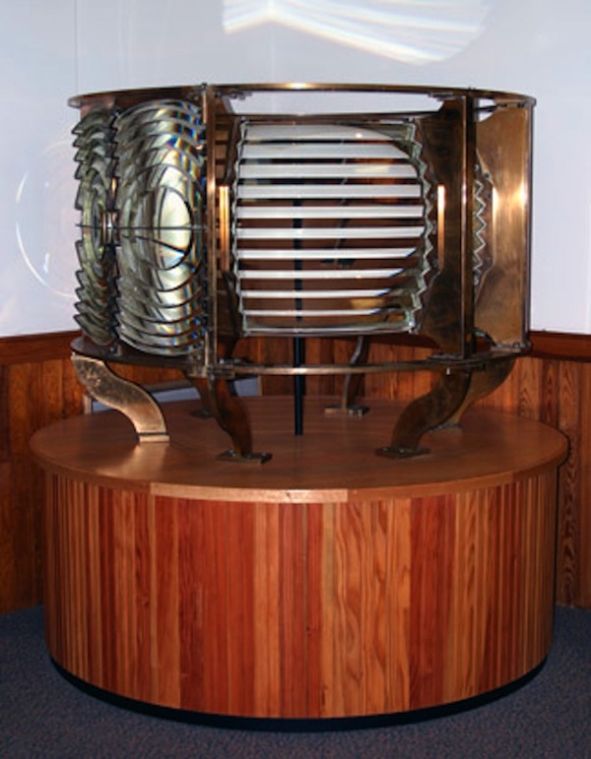 The Town Council voted recently to return the lighthouse lens now on display at the Cape Elizabeth town office to the U.S. Coast Guard. However, the Coast Guard said Tuesday the town will have to cover the significant cost of packing and moving the historic artifact. Courtesy photo
Comments are no longer available on this story