
Long before Hurricane Katrina blew its way through the Gulf states, Tabitha Stevens, a 32 year-old stay-at-home mom from Windham was looking forward to visiting her parents, Jeanne and Robert Stevens, in Columbia, Mississippi.
“I was going down for my daddy’s birthday,” she said.
She had her plane ticket but Katrina had other plans.
After discovering all flights were cancelled, Tabitha, a River Road resident, packed her car and took off with her 15-year-old son, Casey Ward, for Mississippi to be with her father for a birthday none of the family would ever forget.
Columbia, Mississippi sits less than 150 miles from New Orleans. And, although this region was not devastated to the same degree by the hurricane’s wrath, homes and businesses suffered major damage and were without power, water or phone service for some time after the storm.
Though her pictures may show the damage, to be in the midst of it is to experience it fully, she said, including oppressive heat that intensifies the stench of raw sewage and unwashed bodies; the humidity that debilitates the people, just as the storm first debilitated them.
In many small pockets of the area, residents were stranded from any outside contact, with no access to food or water.
“There are still small communities in the area that have received no help,” said Tabitha’s mother, Jeanne, in a phone interview. “Tabitha and her dad collected a pick-up truck full of supplies and delivered them to a small community up near Moselle, Mississippi.”
Tabitha, who has her real estate license and is a notary public, said they took her father’s pick-up to a local Wal-Mart parking lot and put a sign on the side: “Can you please help someone else?”
People kept donating items – even those who had next to nothing themselves.
“I couldn’t live with myself if I didn’t do something,” Tabitha said.
During her 10-day stay in the ravaged town, Tabitha drove around the area, observing the damage done by the hurricane itself and by the tornadoes it spawned.
“I’ve never seen anything like it,” Tabitha said. “Trees were uprooted from the earth.”
Her parents’ home fared pretty well – only three treetops came crashing through the roof. And since her father climbed up and patched it as best he could, water damage was limited.
Neighbors pitched in to clear trees off the road so people could get out.
But many people did not fare as well and were left without basic necessities.
“The food and gas lines,” Tabitha said. “Cars were stretched for miles, lines were unbelievable.”
One of the hardest things for Tabitha was seeing people wait for food with armed guards standing close by.
And the children. She would see them standing in line for hours waiting for food and water with their moms and dads.
Often, it was in those lines that neighbors would see other neighbors for the first time after the storm and ask, “How did you fare?” or “Have you heard from anybody?” or “What do you know, what can you tell us?”
Though residents in the Columbia area recognize they were fortunate in comparison to those in New Orleans and are grateful, at the same time there are many who feel forgotten, overlooked, or second rate, she said.
“If you’re a big city, you got it made,” Jeanne said. “If you’re a small town, just hold your breath.”
Tabitha also believes many of the people “feel the government failed them.”
“They were disappointed that the government wasn’t there to help the way they always said they would,” she said. “It’s not like New Orleans being below sea level was a surprise.”
But overall, Tabitha is amazed at people’s resilience and positive outlook.
“I talked to a teacher from Biloxi while we were getting gas,” Tabitha said. “Her whole apartment complex had been totally wiped out but she wasn’t angry. She just said, ‘All you can do is move on.'”
Tabitha’s experience has spurred her to move on to raise money here in Maine. She plans to seek out ways to help the victims of Hurricane Katrina rebuild their lives.
As she reflects on all she’s witnessed during her stay in Mississippi, Tabitha believes that through this tragedy, people in Columbia may have gained as well as lost.
“The people are rediscovering neighbors,” she said, “and realizing that people are the most important things.”
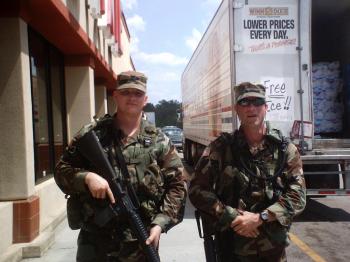 Ice was next to impossible to come by in Colombia, Mississippi when Windham resident Tabitha Stevens visitied family in the hurricane’s aftermath. Two National Guardsmen kept watch over this cache.
Comments are no longer available on this story